A gas pressure washer is not automatically the fastest or most suitable choice for a commercial wash bay. You need to match working pressure, water flow, vehicle volume, ventilation, water supply and maintenance support before comparing models. By the end, you can specify the right duty point, identify when petrol power is unsuitable and prepare a supplier checklist for a Coimbatore installation.
Key takeaways
- Start with 100–150 bar and 8–12 L/min for exterior passenger-car washing.
- Choose electric power for enclosed bays and gas power for open, mobile sites.
- Use wide-angle nozzles and keep the lance away from paint, seals and trim.
- Compare pump duty, service support, spares and safety controls before buying.
Start with the duty point: pressure, flow and daily vehicle volume
Choose the duty point before choosing the engine: for exterior passenger-car washing, start around 100–150 bar at the pump and 8–12 L/min. Working pressure matters more than the advertised maximum or burst pressure; excess pressure adds risk to paint, trim and seals without necessarily increasing cleaning speed.
| Use case | Practical duty point | Selection implication |
|---|---|---|
| Passenger cars | 100–130 bar, 8–10 L/min | Gentle cleaning with manageable water demand |
| SUVs and vans | 120–150 bar, 10–12 L/min | More flow helps remove larger areas of dirt |
| Heavily soiled fleets | Up to 150 bar, 12 L/min | Confirm pump, nozzle and duty-cycle capacity |
Flow controls rinsing speed. Holding the trigger at 8 L/min delivers 480 L/hour; at 12 L/min, it delivers 720 L/hour. Actual consumption falls when the operator releases the trigger, so size a pressure washer for car wash business around trigger time, tank storage, refill rate and drainage.
Match the figures to wash-bay count, daily vehicle volume and duty cycle. Passenger cars need less aggressive cleaning than SUVs, commercial vans and heavily soiled fleet vehicles. For a gas pressure washer car for wash in Coimbatore, compare hydraulic power using bar × L/min ÷ 600: 150 bar at 12 L/min equals 3.0 kW hydraulically.
Before buying, require:
- A pump curve showing pressure and flow together
- A nozzle chart with the correct orifice for that duty point
- Confirmation that the water supply meets the pump’s inlet-flow requirement
Choose the right power source for the wash-site layout
A gas powered pressure washer suits a site with limited electrical capacity or a machine that must move between locations. Petrol brings noise, exhaust, fuel handling, engine-oil changes and air-filter, spark-plug and pump maintenance. Electric machines are quieter and simpler to maintain, but require a correctly sized circuit and adequate supply capacity.
| Option | Strength | Main limitation | Best fit |
|---|---|---|---|
| Petrol | Mobile; independent of site electricity | Exhaust, fuel and engine maintenance | Open-air bays with limited electrical capacity |
| Single-phase electric | Lower noise; simpler servicing | Circuit load limits flow or runtime | Small, quieter wash sites |
| Stationary three-phase | Reliable high-volume operation; fixed plumbing | Needs dependable three-phase supply | Permanent, busy wash bays |
A commercial gas pressure washer is the wrong choice inside an enclosed detailing bay, beside noise-sensitive premises, for low daily volume or where unattended automatic washing is planned. Dependable three-phase electricity usually wins for a fixed, high-volume bay because it avoids refuelling and engine downtime.
For a Coimbatore site, confirm these conditions before choosing petrol power:
- Operate outdoors or in a genuinely open, well-ventilated area; separate exhaust from rooms, doors, windows and air intakes because carbon monoxide can accumulate without visible smoke.
- Provide drainage, rain protection and a stable equipment location; do not trap exhaust beneath a roof or against walls.
- Measure sound at the property boundary. Check the 65/55 dB(A) day/night commercial limits under India’s Noise Pollution Rules, especially near homes.
- Store petrol away from exhausts and ignition sources under applicable Petroleum Rules and PESO requirements. Control spills, and never refuel a hot or running engine.
Decide whether portability helps or hinders a fixed bay
A portable gas pressure washer usually hinders a permanent bay when operators drag it between vehicles. Park the hot, vibrating engine in one protected position and use a sufficiently long high-pressure hose; small wheels and an unstable frame invite collisions, hose kinks and exhaust exposure.
| Feature | Fixed-bay preference | Check before purchase |
|---|---|---|
| Wheels and frame | Large pneumatic wheels, wide stable frame | Ground clearance and tipping during hose pulls |
| High-pressure hose | Long, flexible hose | Pressure, temperature and chemical ratings, not length alone |
| Water connection | Correct inlet size and tank compatibility | Pump flow requirement, hose diameter and open-valve supply |
| Starting and fuel | Electric start for frequent use; recoil as backup | Petrol-tank capacity, run time and safe storage |
| Pump protection | Low-water protection and thermal unloader | Thermal relief or manufacturer-approved bypass protection |
| Pump and service | Brass head, replaceable seals, accessible parts | Aluminium is lighter; confirm seals, unloaders and spares |
| Priming and storage | Easy priming, drainable lines and covered storage | Air removal before operation and protection from dust and rain |
The source must deliver the pump’s required flow through a fully open valve and suitable hose. A mesh inlet filter catches tank sediment; it cannot correct a low water level, air ingestion, an undersized hose or cavitation. Vibration and unstable pressure signal trouble.
Stop the machine during pauses. Leaving the pump in hot bypass overheats recirculated water and damages seals, even on a commercial gas pressure washer.
Match nozzles, foam and safe washing practice to each vehicle
Foam performance depends on flow, injector pickup and nozzle compatibility, not pressure alone. A downstream injector reduces pressure and needs enough water flow to draw detergent; a foam lance needs the correct nozzle and detergent draw rate. Check chemical compatibility and rinse performance instead of trusting “foam-cannon ready.”
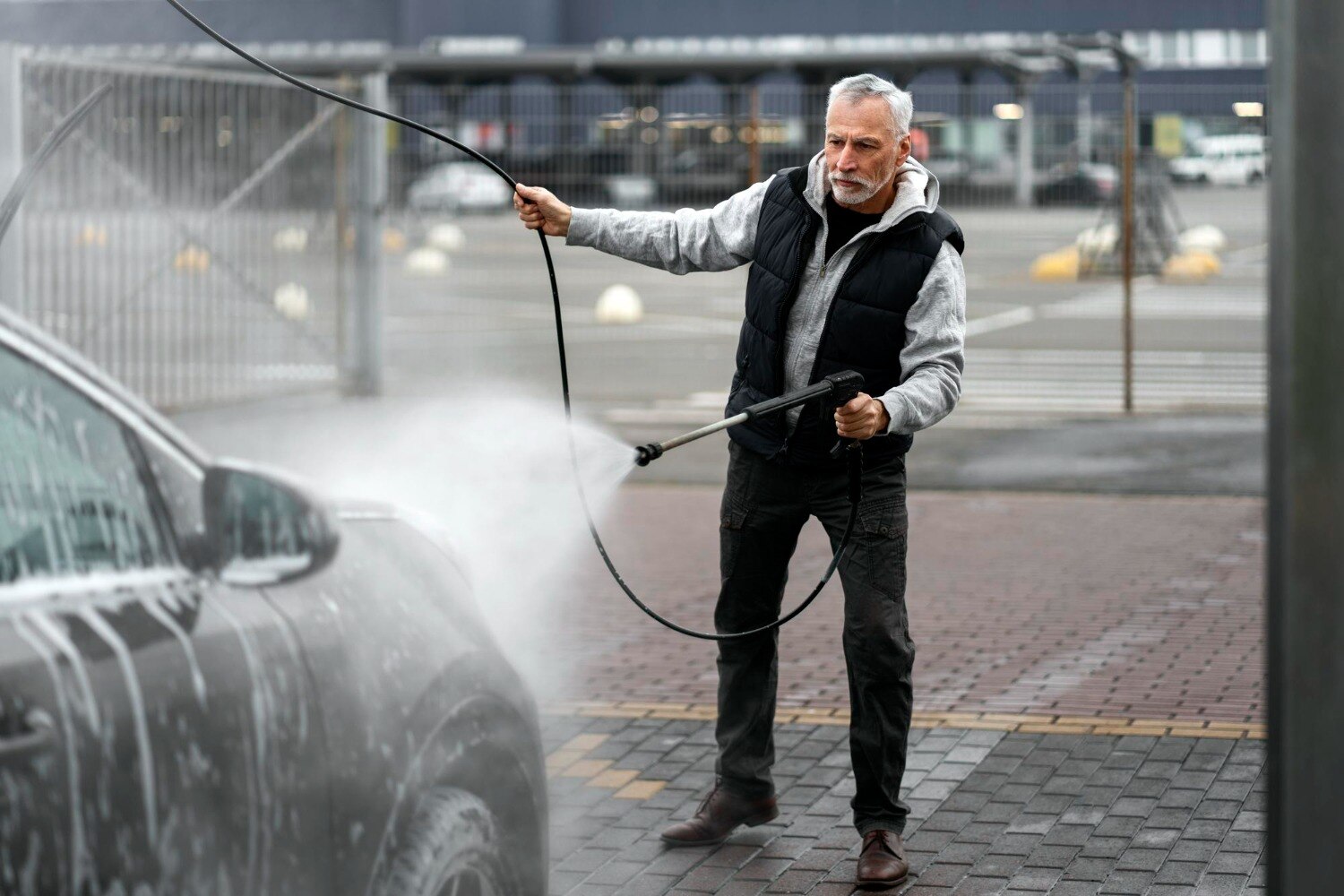
1. Fit interchangeable fan nozzles sized to the pump’s rated flow and working pressure. An undersized orifice can overload the pump, engine or unloader; an oversized one produces weak cleaning. 2. Use a broad fan pattern, keep the wand moving, and test spray distance on an inconspicuous area.
Never use a zero-degree pencil jet on paint, tyres, rubber seals or emblems. 3. Set the wash method to the vehicle: - Passenger cars: moderate pressure, wider fan, pre-rinse and gentle detergent. - SUVs: the same safe fan pattern, with extra dwell time for wheel arches and underbody dirt.
- Vans: longer hose reach and more rinse flow for larger panels. - Heavily soiled fleets: pre-soak, suitable detergent and repeated broad-fan passes, not a closer jet. 4. Dilute chemicals to the manufacturer’s ratio, wear gloves and eye protection, and keep spray away from alternators, connectors, fuse boxes, sensors and other electrical components.
Control wastewater with settling or solids removal, oil separation where needed, filtration and scheduled reclaim maintenance. Do not pump settled mud back through the machine. Use fresh or treated water for the final rinse when spotting matters.
A gas powered pressure washer does not remove water restrictions or discharge obligations; a pressure washer for car wash business still needs compliant drainage.
Use a supplier checklist before buying a commercial unit in Coimbatore
A quoted commercial gas pressure washer is comparable only when its working duty and support package are documented. Use this checklist with GMS Car Wash Equipments, without assuming every listed washer is gas-powered:
- Ask for the nameplate working pressure and flow, pump model, engine model, pump curve, nozzle chart, hose rating and inlet requirement.
- Record fuel consumption, expected run time, warranty, service interval and replacement-parts lead time.
- Check for a dust-suited engine air filter, accessible spark plug, pump-oil service instructions, inlet filtration, pump seals and unloader parts.
Ask how the unit will resist Coimbatore heat, dust, monsoon water ingress, hard-water deposits and fuel-storage risks. For a gas pressure washer car for wash in Coimbatore, confirm the pump’s 100–150 bar at 8–12 L/min duty point rather than a larger burst-pressure claim.
| Quote item | What to verify | Decision effect |
|---|---|---|
| Power source | Petrol engine, electric motor or three-phase connection | Do not compare fuel use with electrical load as if they were the same machine |
| Performance | Pump curve and nozzle chart at the stated pressure and flow | Reject unsupported headline ratings |
| Support | Local service and spares for both engine and pump | Shorter downtime than a higher-rated machine with imported seals |
Choose gas only for a ventilated, fuel-compliant site where mobility or limited electrical capacity justifies added noise, exhaust and maintenance.
Related products
 | Vehicle Washer Car Pressure Washer Supplier In Coimbatore GMS Engineering vehicle washer pumps are highest standards to give a trouble-free performance. View product → |
 | Vehicle Washer High Pressure Garage Car Washer In Coimbatore | GMS Engineering We are leading manufacturers, Suppliers, Exporters of Car Washer. View product → |
Frequently asked questions
What pressure and flow suit a Coimbatore car wash?
For exterior passenger cars, start around 100–150 bar at the pump and 8–12 L/min. Judge the unit by working pressure, not its advertised maximum or burst pressure.
When is a gas-powered pressure washer the right choice?
Choose a gas-powered pressure washer when the wash site needs mobility, high water output or operation away from dependable electrical supply. Do not run a petrol engine in an enclosed bay because exhaust gases create a serious hazard.
Does a portable gas pressure washer suit a fixed wash bay?
Portability helps when one machine serves multiple bays or outdoor areas. In a fixed bay, wheels, fuel handling and engine noise can hinder workflow, so compare them with a permanently positioned unit.
What should you check before buying a commercial gas pressure washer in Coimbatore?
Check working pressure, flow rate, pump type, hose length, nozzle set, foam equipment, engine access, spare-parts availability, warranty terms and local service response.
Related products
 | Vehicle Washer Car Washer Pump Manufacturer In Coimbatore Car Washer Pump manufacturer In Coimbatore | GMS Engineering View product → |
 | Steam Car Washer Steam Car Washer in Coimbatore | GMS Engineering GMS Engineering steam car washer is a device that uses high-pressure, hot water or steam to clean the interior and exterior of a... View product → |
Keywords