The right choice depends on how many vehicles you wash, how often you hit delivery-detailing peaks, and whether your dealership already has a suitable pressure washer or compressor. By comparing workload, operating utilities, cleaning method, vehicle finishes, and service requirements, you can choose equipment that improves throughput without mistaking thicker foam for better cleaning.
Key takeaways
- Choose an 800 ml foam gun for occasional washing and short hose runs.
- Choose a foam machine when vehicle volume, refill time, and consistent coverage matter.
- Use pre-rinse, dwell time, and clean wash media to reduce paint marring.
- Test foam output, pressure, detergent compatibility, drainage, and operator safety before purchase.
Match the equipment to your dealership’s workload
An 800 ml handheld foam gun is sufficient when you wash a small number of display, delivery, or service-lane vehicles intermittently. It suits a bay with an existing pressure washer, short hose runs, and an operator who can refill the bottle between cars.
Choose it for light daily demand, not a queue of vehicles requiring uninterrupted coverage.
| Option | Best workload | Main advantage | Limitation |
|---|---|---|---|
| 800 ml handheld foam gun | Occasional display, delivery, or service-lane washing | Low setup, compact storage, and no separate air system | Frequent refills and less consistent coverage during repeated washing |
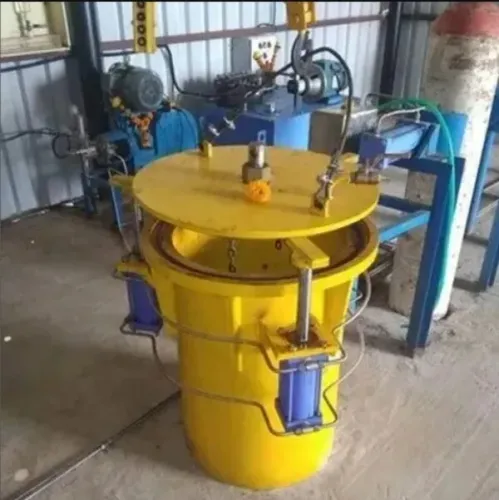
| 70-litre pneumatic tank | Used-car reconditioning, delivery-detailing peaks, or several active bays | Large chemical capacity, low-pressure application, and repeatable foam output | Requires compressor capacity, drainage space, hose management, and planned maintenance |
A 70-litre pneumatic tank is justified when refill interruptions consume labour, several operators need foam during the same shift, or the pressure washer must remain available for rinsing.
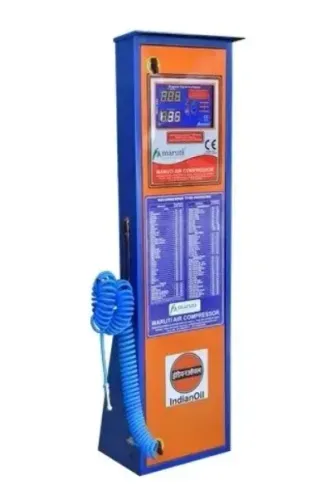
It is also useful when consistent low-pressure coverage matters across a large used-car intake, but only if the compressor maintains the specified 2.4–3.8 bar range without excessive recovery delays. Check receiver size, air consumption, regulator stability, and hose length; pressure on the gauge alone does not prove sustained output.
For a foam gun or foam machine for car washing, count complete wash cycles rather than judging foam thickness. Record vehicles per shift, peak-hour demand, bay count, operator travel, chemical storage, and refill time before choosing.
Compare throughput, utilities, effort, and ownership cost
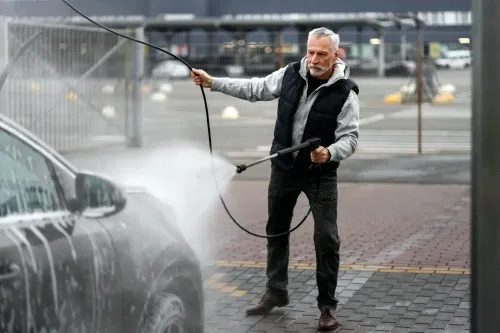
An 800 ml pressure-washer foam gun usually wins for intermittent dealership washing: it sets up quickly, shares the existing washer, and stores in little space. Refills interrupt work sooner, and foam consistency changes with nozzle condition, water flow, detergent level, and operator technique.
| Option | Throughput and effort | Utilities, ownership, and fit |
|---|---|---|
| 800 ml foam gun | Fast setup, but frequent refills during delivery peaks or used-car reconditioning | Uses the pressure washer; low purchase and maintenance cost; minimal storage; pressure and flow determine foam quality |
| 70-litre pneumatic tank | Covers repeated vehicles with fewer refills and steadier low-pressure application | Needs compressed air, hoses, fittings, drainage space, and regulator control; higher purchase, cleaning, and repair cost |
| Dedicated foam machine | Reduces operator travel when foam application runs separately from rinsing | Justified when the washer must rinse another bay; air compressor capacity and recovery time become operating costs |
A 70-litre tank earns its space when several bays apply foam continuously, consistent coverage matters, or simultaneous foaming and rinsing raises daily throughput. Otherwise, paying for an air system, receiver capacity, storage, and maintenance adds cost without removing the main bottleneck: pre-rinse or final-rinse capacity.
Include labour and refill time in ownership cost. Check the compressor at the stated 2.4–3.8 bar range, then measure recovery with the actual hose length and fittings.
Ask for recorded detergent dilution, inlet flow, air consumption, and coverage using your water and chemical; weak foam often comes from a blocked pickup filter or inadequate flow, not from the machine itself.
Build a wash process that cleans without creating marring
A foam gun or foam machine for car washing reduces marring only when it supports the entire wash cycle. Foam loosens and lubricates soil; it does not remove the released grit without a thorough rinse.
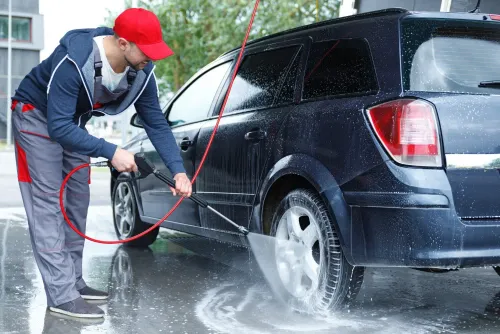
1. Pre-rinse with clean water from the roof downward, working around glass, trim, panels, wheels, and lower sills. Use enough pressure and flow to flush loose sand away before any mitt, brush, or towel touches the vehicle.
2. Dilute the detergent according to its label, measuring chemical and water rather than judging by foam thickness. Incorrect concentration leaves residue, weakens cleaning, or increases rinsing effort; hard water and hot panels can change the result.
3. Apply foam from the bottom upward or according to the chemical manufacturer’s direction, covering one manageable area at a time. A pressure-washer lance suits intermittent washing; a pneumatic foam machine helps maintain consistent coverage across repeated dealership cycles.
4. Control dwell time with a timer or bay rule. Keep the vehicle shaded, cool, and wet, and rinse before the foam dries; never let detergent concentrate on hot paint or glass. Longer dwell is not automatically better.
5. Rinse at high pressure from the roof downward until no visible foam or loosened soil remains, giving extra attention to badges, panel gaps, mirrors, and lower sections. Do not wipe while grit remains; contact washing before this rinse turns contamination into scratches.
6. Inspect the rinse, then use a clean, lubricated mitt and separate wheel tools only if contact cleaning is still necessary. Flush the equipment after use so dried detergent does not restrict the nozzle, injector, hose, or tank.
Check detergents, finishes, and equipment safety before daily use
Before the first vehicle, verify that the detergent is labelled safe for clearcoat, glass, rubber, plastics, aluminium, and any ceramic or matte finishes in dealership stock. Check dilution, pH, batch condition, and the safety data sheet; household dish soap, unapproved degreasers, and mixed chemicals can strip protection, stain trim, or attack seals.
- Test a small hidden panel on each unusual finish. Stop if the surface becomes hazy, tacky, or discoloured.
- Keep foam off hot panels and direct sun. Dried detergent concentrates soil and leaves spots that need aggressive rinsing.
- Do not extend dwell time to compensate for weak dilution. Rinse before the foam dries, using a clean nozzle and enough water to remove suspended grit.
- Match the pressure washer’s measured flow to the gun’s injector requirement; excess pressure does not correct insufficient flow. Flush the injector, hose, and lance after use, and never run a pump dry.
- For a machine, drain moisture from the air line, inspect the regulator and safety valve, and release pressure before disconnecting fittings.
Check the foam gun versus foam machine choice against these daily-use risks:
| Check | Foam gun | Foam machine |
|---|---|---|
| Chemical path | Confirm injector, hose, and seals tolerate the detergent | Confirm tank, air valve, gasket, and pickup tube compatibility |
| Application pressure | Keep the lance off paint, glass edges, and trim | Use low-pressure coverage without forcing foam into locks or vents |
| After-use care | Flush detergent from the injector | Rinse the tank and depressurise it |
| Damage warning | Do not let foam dry | Do not exceed tank or regulator limits |
Specify and test the equipment before you buy
A supplier’s quotation should describe a measured wash result, not simply “thick foam.” Before accepting equipment, test it with your own pressure washer, water, detergent, hose length, compressor, and expected operating temperature.
1. State the operating principle: hose-end sprayer, pressure-washer foam lance, or compressed-air applicator. Ask the car wash foam equipment supplier to measure and record inlet pressure, inlet flow, detergent dilution ratio, foam output, coverage area per minute, and air consumption where applicable.
2. Run a complete bay trial. Record pre-rinse time, foam application time, refill time, dwell time, rinse time, and the number of vehicles completed before pressure or foam quality changes. Test the 800 ml gun against the 70-litre machine if both are under consideration; advertised foam thickness alone does not predict throughput.
3. Put acceptance limits in writing. Specify the operating pressure and temperature, acceptable dilution range, coverage uniformity, recovery time between vehicles, and leakage tolerance. Check that the spray pattern reaches the vehicle without forcing the operator to shorten the hose or move equipment repeatedly.
4. Request a parts and service schedule covering the injector orifice, pickup tube, chemical filter, seals, couplings, spray nozzle, air regulator, and pressure gauge. Confirm replacement availability and cleaning instructions.
For a car wash foam gun in Coimbatore, GMS Car Wash Equipments should document the same site trial rather than quote only catalogue figures. Include drainage, chemical storage, and wastewater controls in the layout before installation.
Related products
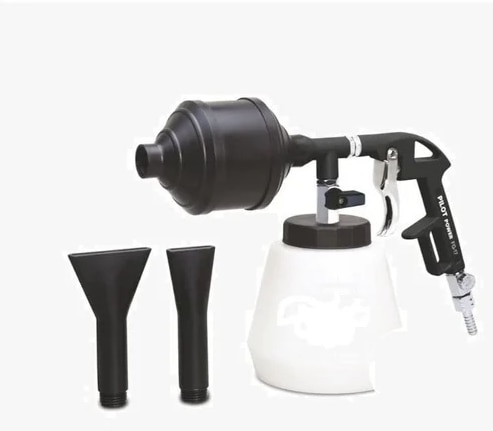 | Car Wash Foam Gun GMS Car Wash Equipments offers premium quality Car Wash Foam Guns designed to deliver thick, rich foam for effective and scratch-free vehicle... View product → |
 | Vehicle Washer Car Foam Wash Machine In Coimbatore | GMS Engineering We are offering car foam washing machine. Specifications-: 1)produce the certain pressure using the compressed air in the machine... View product → |
Frequently asked questions
When is a foam gun better than a foam machine for dealership washing?
An 800 ml handheld foam gun suits intermittent washing of display, delivery, or service-lane vehicles when a pressure washer already exists. Choose it when an operator can refill between cars.
When should a dealership choose a foam machine?
Choose a foam machine when daily vehicle volume makes bottle refilling slow, consistent foam coverage matters, or several operators need repeatable results.
Does more foam clean a vehicle better?
No. Cleaning depends on detergent dilution, surface coverage, dwell time, pressure, rinsing, and clean wash media. Thick foam alone does not remove bonded contamination.
How can a dealership wash cars without creating paint marring?
Pre-rinse loose grit, apply foam, allow the stated dwell time without letting it dry, rinse thoroughly, and use clean mitts or brushes from the least dirty panels downward.
What should you test before buying car wash foam equipment?
Test foam consistency, detergent draw, pressure and flow, hose reach, refill time, drainage, noise, electrical protection, fittings, and performance across the dealership's busiest shift.
Related products
 | Vehicle Washer Car Wash Foam Gun In Coimbatore | GMS Engineering Product Specification : Usage/Application FOAM GUN Material Plastic Is It Portable Portable I Deal In New Only CUP CAPACITY 800ml... View product → |
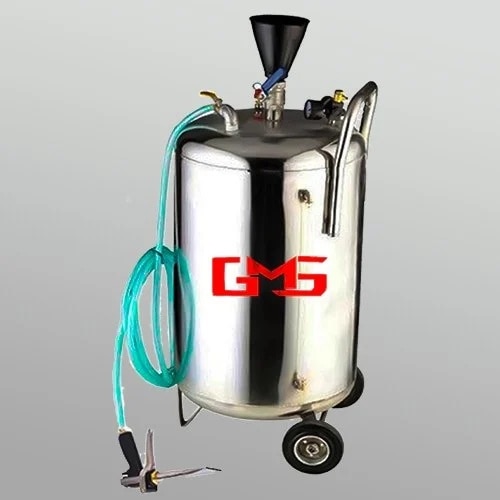 | Auto Garage Equipments Stainless Steel Foam Car Wash Equipment Stainless Steel Foam Car Wash Equipment In Coimbatore | GMS Engineering Product Details: Motor Power PNEUMATIC Size 70 LT Usage/Application AIR... View product → |
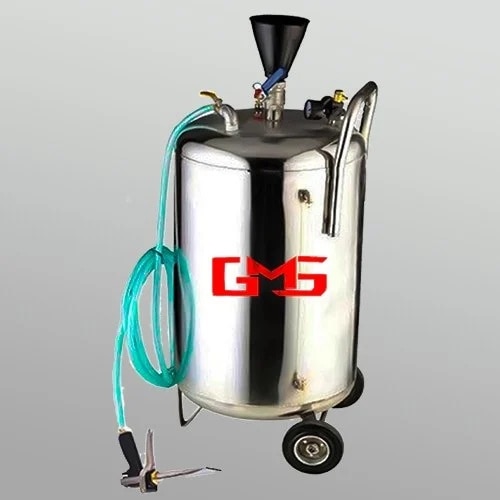 | Garage Equipments Car Wash Foam Machine In Coimbatore | GMS Engineering material stainless steel or iron tank capacity 70l working pressure 2.4-3.8bar relief valve 3.5 kg length delivery hose 5.0m... View product → |
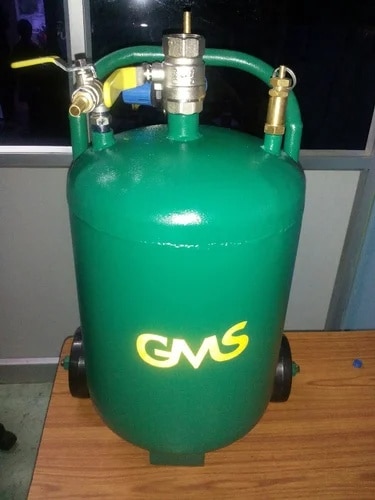 | Auto Garage Equipments Pneumatic Car Foam Washer In Coimbatore Pneumatic Car Foam Washer In Coimbatore | GMS Engineering View product → |
Keywords