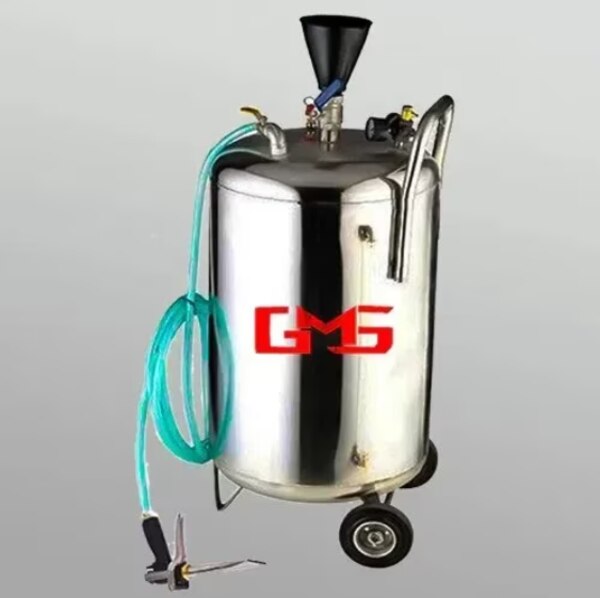
A 70-litre label does not tell you whether a foam machine will produce consistent coverage, work with your compressor, or survive daily detergent exposure. By checking the vessel, air supply, foam-output data, usable fill volume, operating method, and included components, you can compare quotations and identify the equipment needed for a workable wash bay.
Key takeaways
- Choose compressed-air foam machines for vessel-based foam, not pressure-washer cannons.
- Match working pressure, compressor output, and hose connections before installation.
- Estimate cars per 70-litre charge from dilution, spray time, and foam consumption.
- Confirm tank material, drain fittings, accessories, power supply, and after-sales support.
Start with the Correct Foam-Machine Category and a Complete Specification Table
A pressure-washer foam cannon is not the same as a compressed-air foam machine. The cannon draws detergent into the washer’s high-pressure water stream; the compressed-air model pressurises diluted solution inside a vessel. For a car foam wash machine for specifications in Coimbatore, compare the correct category first.
| Option | Tank specification | Compatibility and corrosion | Dimensions and handling | Mounting and drainage |
|---|---|---|---|---|
| Stainless steel | Grade, tank thickness, nominal geometric capacity, recommended working volume | Internal finish, alkaline, acidic, chloride and solvent limits; corrosion resistance | External dimensions, footprint, empty weight, filled weight | Floor or trolley mount, wheel diameter, brake, drain height, residual liquid |
| Iron | Steel grade, tank thickness, nominal geometric capacity, recommended working volume | Internal coating type and thickness, coating repair limits, detergent restrictions, corrosion resistance | External dimensions, footprint, empty weight, filled weight | Floor or trolley mount, wheel diameter, brake, drain height, residual liquid |
Treat “70 litres” as nominal tank capacity until the quotation states usable working volume. Ask for the safe fill level, expansion space, residual liquid after draining, vessel test pressure, maximum working pressure, recommended operating pressure, and relief-valve setting.
A full 70-litre water-based charge adds roughly 70 kilograms before the tank, hose and fittings. Confirm filled weight and floor loading before choosing a trolley or fixed unit.
Ask the supplier to mark each item as included or excluded: pressure gauge, relief valve, air inlet, chemical-resistant hose, foam nozzle, drain and depressurisation valve.
Verify Pressure Ratings, Compressor Capacity, and Connection Sizes
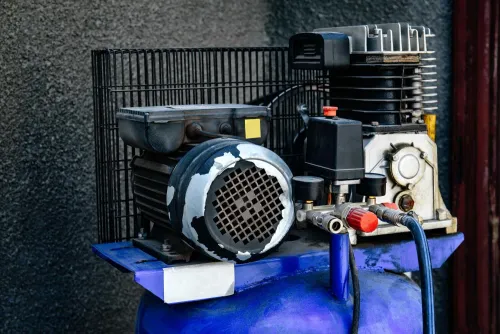
Safe continuous operation depends on the compressor’s delivered air, not merely the pressure shown on its receiver. A small compressor can reach the target pressure yet deliver too little air, causing repeated cycling, slow recovery, and weak foam during continuous washing.
Require every pressure figure in bar or kg/cm²; if both appear, state the conversion: 1 kg/cm² equals 0.981 bar. The quotation must distinguish maximum allowable vessel working pressure, recommended operating pressure, hydrostatic or other pressure-test basis, and relief-valve set pressure. Set the relief valve below the vessel’s permitted working pressure.
The gauge, regulator, and relief valve are safety equipment, not optional accessories.
Ask the supplier to confirm each item below:
- Compressor horsepower, receiver capacity in litres, free air delivery in CFM or L/min at a named pressure, duty cycle, inlet pressure, and air-line connection size.
- Air inlet thread form, coupler type, pipe size, and whether a filter, regulator, and water separator are supplied.
- Liquid outlet size, hose specification, and every adapter required to connect the machine to your existing wash-bay plumbing.
- Vessel inspection or test documentation, including the tank’s pressure-test basis and operating limits.
- Recommended regulator setting and the procedure for depressurising before opening the lid, removing fittings, or clearing a blocked nozzle.
Record these details against the workshop compressor, not a catalogue assumption. That makes the car foam wash machine equipment usable in practice rather than compatible only on paper.
Compare Foam Output Through Consumption, Reach, and Chemical Controls
A 70-litre tank or high maximum pressure does not predict cleaning coverage. Compare the foam produced per vehicle, the area reached, and the chemical used at the stated working pressure.
Measure these figures on the same basis:
- Chemical consumption: litres per minute and litres per vehicle
- Foam volume or air-to-liquid ratio, spray reach, nozzle orifice diameter, and hose length
- Working pressure used for every quoted figure
- Adjustable air and chemical controls, calibrated chemical metering, or manual premixing
- Dilution range for high-foaming car shampoo, pH-neutral shampoo, and snow-foam concentrate
| Specification | Weak quotation | Useful comparison |
|---|---|---|
| Foam output | “High foam” | Foam volume or air-to-liquid ratio at a stated pressure |
| Chemical use | Tank capacity only | Litres per minute or per vehicle at a stated dilution |
| Coverage | “Long reach” | Spray distance, nozzle diameter, and hose length |
| Controls | “Adjustable” | Separate air and chemical ranges, with calibration stated |
| Water | No assumption | Hardness level or test-water condition used |
Do not assume pressure-washer detergent or solvent suits a foam machine. Water hardness changes foam stability, while excess chemical creates dry, unstable foam, residue, higher cost, and faster seal deterioration; too little produces thin coverage. Confirm compatibility with alkaline detergents, acidic wheel cleaners, chlorides, solvents, hoses, valves, seals, and the tank’s internal surface.
These are the car foam machine details in coimbatore that support an actual wash-performance comparison.
Use the Tank Correctly and Estimate Cars per 70-Litre Charge
1. Measure water and shampoo within the supplier’s stated dilution range. For a 70 litre foam machine in coimbatore, do not assume 70 litres is usable capacity; leave the specified expansion space below the fill opening. Close the cap securely.
2. Connect the compressor and air line, then check the gauge and regulator. Pressurise only to the recommended working pressure, never the vessel’s maximum limit. Open the liquid and foam controls and apply an even coat.
3. Keep the foam wet during its dwell time. Agitate areas that need extra cleaning, then use a high-pressure rinse; the foam generator does not replace the rinse pump. Excessive overlap or a wide spray pattern increases solution consumption.
4. After spraying, close the outlet, isolate the air supply, and depressurise through the designated valve. Never open the lid, remove a fitting, or clear a blocked nozzle while pressure remains in the vessel.
5. Drain leftover solution, rinse the tank and hose with clean water, flush the nozzle, and leave the vessel depressurised. To estimate coverage, record litres consumed while washing one small, one medium, and one large vehicle, then use this calculation:
Usable working volume ÷ measured litres consumed per vehicle = estimated vehicles per charge
Record the solution left after the final vehicle. Operator speed, spray overlap, vehicle size, foam settings, and refilling between cars can change the result, so report a measured range rather than an invented car count.
Check Included Equipment, Site Compatibility, and Supplier Support
A complete quotation must show every pressure and connection component, not just tank capacity. For car foam wash machine equipment, require these items by name: pressurised tank, fill cap, pressure gauge, safety relief valve, air inlet valve, liquid outlet, chemical-resistant hose, foam lance or nozzle, shut-off and control valves, drain, and a defined depressurisation arrangement.
| Option | Confirm on the quotation | Why it matters |
|---|---|---|
| Stainless steel | Tank thickness, grade, corrosion resistance, dimensions, empty weight, usable fill volume | Better resistance to detergent and water exposure, but compare replacement cost |
| Iron | Coating, tank thickness, corrosion protection, dimensions, empty weight, usable fill volume | Lower initial cost can bring earlier rust or coating failure |
| 70 litre foam machine in Coimbatore | Nominal capacity, safe fill level, expansion space, residual liquid, and filled weight | “70 litres” often describes geometric capacity, not usable solution |
Mark each item as included or excluded:
- Compressor, pressure washer, water source, detergent, hose reel, electrical supply, wash-bay drainage, air filter, regulator, water separator, thread adapters, and installation consumables.
- Ask for inlet-water pressure and quality assumptions, air connection standard, thread form, coupler type, pipe size, and filtration requirement. A supplier such as GMS Car Wash Equipments adds value by matching these interfaces to your wash-bay layout.
Request the vessel’s inspection or pressure-test basis, maximum allowable and operating pressures, cleaning instructions, and warranty terms. Separate vessel coverage from wear parts such as hoses, trigger valves, seals, check valves, nozzles, and regulators, then confirm their availability and replacement prices.
Related products
 | Vehicle Washer Car Foam Wash Machine In Coimbatore | GMS Engineering We are offering car foam washing machine. Specifications-: 1)produce the certain pressure using the compressed air in the machine... View product → |
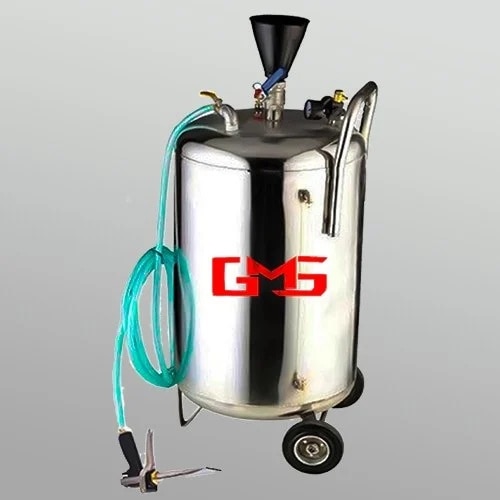 | Garage Equipments Car Wash Foam Machine In Coimbatore | GMS Engineering material stainless steel or iron tank capacity 70l working pressure 2.4-3.8bar relief valve 3.5 kg length delivery hose 5.0m... View product → |
Frequently asked questions
What is the difference between a foam cannon and a compressed-air foam machine?
A pressure-washer foam cannon injects detergent into a high-pressure water stream. A compressed-air foam machine pressurises diluted solution inside a tank and mixes it with air.
Which specifications should you verify before buying a car foam wash machine?
Check working and test pressure, tank capacity, compressor capacity, air and water requirements, hose length, connection sizes, nozzle type, chemical controls, and power supply.
How many cars can a 70-litre foam machine wash?
The number depends on solution dilution, vehicle size, spray duration, nozzle flow, and operator technique. Estimate it by dividing usable solution volume by measured consumption per vehicle.
What equipment should be included with a foam wash machine?
Confirm the tank, compressor or air inlet arrangement, hose, foam lance or gun, nozzle, pressure gauge, safety valve, drain arrangement, wheels or frame, and operating instructions.
Related products
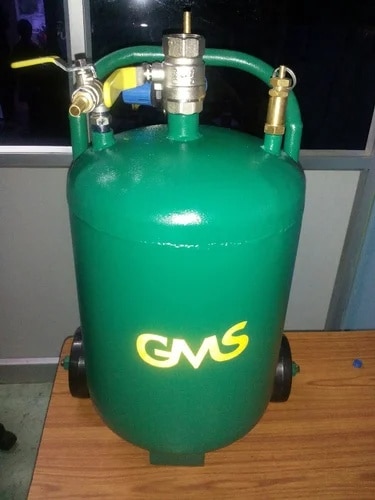 | Auto Garage Equipments Pneumatic Car Foam Washer In Coimbatore Pneumatic Car Foam Washer In Coimbatore | GMS Engineering View product → |
 | Vehicle Washer Car Wash Foam Gun In Coimbatore | GMS Engineering Product Specification : Usage/Application FOAM GUN Material Plastic Is It Portable Portable I Deal In New Only CUP CAPACITY 800ml... View product → |
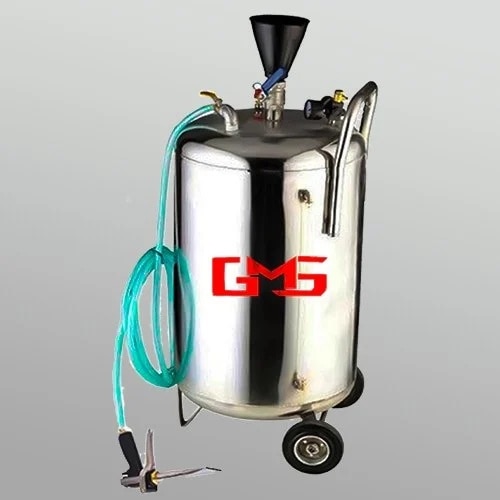 | Auto Garage Equipments Stainless Steel Foam Car Wash Equipment Stainless Steel Foam Car Wash Equipment In Coimbatore | GMS Engineering Product Details: Motor Power PNEUMATIC Size 70 LT Usage/Application AIR... View product → |
Keywords